Showing posts with label freedom. Show all posts

Tuesday, February 7, 2012

FLOWER POWER

Before the 19th century 'nature' was a threat to the (European) civilian rather then a place to enjoy. Since the Romantic art movement of the 19th century (e.g. see Caspar David Friedrich) 'nature' has become something to cherish and respect and even a symbol for freedom and peace.

The Flower Power hippies of the 1960's exploited the idea of nature conquering violence and repression. Iconic is the 'flower-in-gun' picture taken at the Kent State anti-Vietnam-war protests (and shootings) of 1970, an image soon adapted by the soldiers in Vietnam.


Monday, August 8, 2011

ESCAPE ARTIST

Where performance art, taking a chance and the urge for freedom meet: THE ESCAPOLOGIST.

Escape artists have been around for centuries. Of course it is Harry Houdini who made the escape act a recognised entertainment at the end of the 19th century. Nevertheless it was Norman Murray Walters, a contemporary of Houdini, who coined the phrase 'escapology' for his skills.

Sculptor Silvia B. creates wonderfully strange animal-like child creatures who wouldn't misfit the oldtime freak circus, especially when they are posed as contortionists or escape artists.
The ironical fate of 'Numero Noir' is now being transferred to the glass showcase of the art gallery. No escape there ...


Silvia B., 'Numero Noir' (2010) (collection Museum Beelden Aan Zee)

Saturday, May 21, 2011

Big Biedermeier Brother

As the Napoleonic wars left Europe in political disorder the Congress of Vienna drew plans for political restoration of Europe (in effect between 1815 and 1848). As a consequence public life was highly controlled by censorship prompting people to concentrate on the domestic and the non-political. Aestheticly the glorious and militaristic Empire Style made way for a domestic and bourgeois (floral) style, later named Biedemeier, ironically after the pseudonyme of a parodist of the time.

In 1948 George Orwell penned down his fears for a controlled society. Partly because of Orwell's warnings in the year 1984 it was still unthinkable that daily life would be monitored 24 hours a day. Meanwhile nobody takes any notice of CCTV and video surveillance anymore, accepting computer monitoring, biometric identification archives and GPS-tracking as a fact of life.

In Burçak Bingöl's series of sculptures titled Günebakan [F(ol)lower] closed circuit surveilance cameras are recreated as ceramic ornaments with floral decorations. They depict nicely the comatose bourgeois acceptance of 'Big Brother'-society.


Burçak Bingöl, 'Günebakan [F(ol)lower] III' (2011)


Burçak Bingöl, 'Günebakan [F(ol)lower] II' (2011)


Burçak Bingöl, 'Günebakan [F(ol)lower] I' (2011)

Showing until 14/06/2011 at Cda Projects in Istanbul.

Friday, December 10, 2010

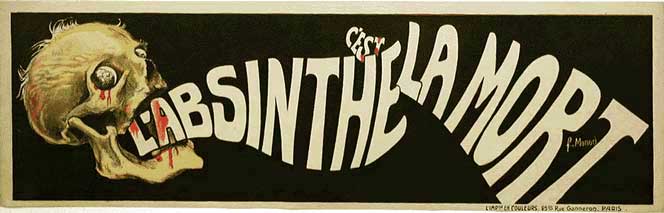
CAGING THE GREEN FAIRY


In the 19th century the Swiss liquor Absinthe was the favored poison among European artists. By the 20th century governements and anti-drink movements were campaigning heavily against the neurotoxic and hallucinous drink.

Prohibition followed soon, starting in Switzerland, where a father killed his entire family after having a few Absinthe drinks. Anti-prohibition movements also emerged soon. The result a battle between the anti-alcohol league of the Blue Cross and the free individual under the Swiss Red Cross.

The prohibition of Absinthe was lifted only a few years ago.


Wednesday, December 8, 2010

BIRDS

The abolishment of slavery in the 19th century is recognized as one of the major turning points in the struggle for freedom. However, at the moment more people are 'owned' or forced to work then ever before.

The struggle to get rid of slavery started in Haïti in the wake of the French Revolution around 1800. Slave trade was illegal in the British Empire by the 1830's, by the 1840's in France and by the 1860's the United States and most other nations in the world followed.

As disagreements over slavery directly led to the American Civil War the abolition of slavery is an essential part of the history of the United States of America.

In this awkward cartoon from 1863 the American Bird of Freedom is congratulating the Black Bird.

Saturday, December 4, 2010

SIGNS

Limiting our movement in a very unconscious and abstract way, the prohibitive warning sign seems to be an entity in itself.
Usually black on yellow, colors indicating danger, some simple words or graphics make us turn back on our heels.


Timm Ulrichs, 'Keep Out Of The Exhibition' (1968/69)


Robert Barta
, 'World Closed Ahead' (2008)

Thursday, December 2, 2010

RESERVED

Freedom for one person will come at the cost of freedom for others. That's how it works.

The video 'Reserved' made by artist Bani Abidi illustrates this perfectly. While a motorcade with governement officials gets freedom to move unhampered through the city the citizen traffic comes to a halt behind the traffic police blockades.

The artist lives and works in Karachi and New Dehli.

These images are stills from her video.


Bani Abidi, 'Reserved' (2006)

Wednesday, December 1, 2010

RUSSIAN TRAMPOLINE

Canadian artist Patrick Bérubé made his installation 'Demi-Mesure' by putting a trampoline in a half-height room.

The installation was among others shown in the exhibition 'Ceci n'est pas un Casino'. In this context the trampoline wonderfully resembles the roulette wheel ... and the chance of winning at the roulette table is probably as big as not bumping your head in Bérubé's installation (not to mention the frustration of lack of freedom inherent to the use of the trampoline!).


Patrick Bérubé, 'Demi-Mesure' (2005)